

<img height="1" width="1" style="display:none" src="https://www.facebook.com/tr?id=356276288176327&amp;ev=PageView&amp;noscript=1">
Skip to content

Dental Practice Transition Advisors

Selling a Dental Practice in Minnesota

TUSK is a sell-side M&A advisor working exclusively for Minnesota dental practice owners. Minnesota is one of the few states where GP consolidators and specialty consolidators are both actively acquiring at the same time. That dual-track buyer bench sharpens competitive tension in any well-run process.

Request a Confidential Valuation

What is your Minnesota dental practice worth?

A confidential valuation, prepared by our team. No commitment. We respond within two business days.

In Minnesota, You Have Two Sets of Buyers Competing for Your Practice.

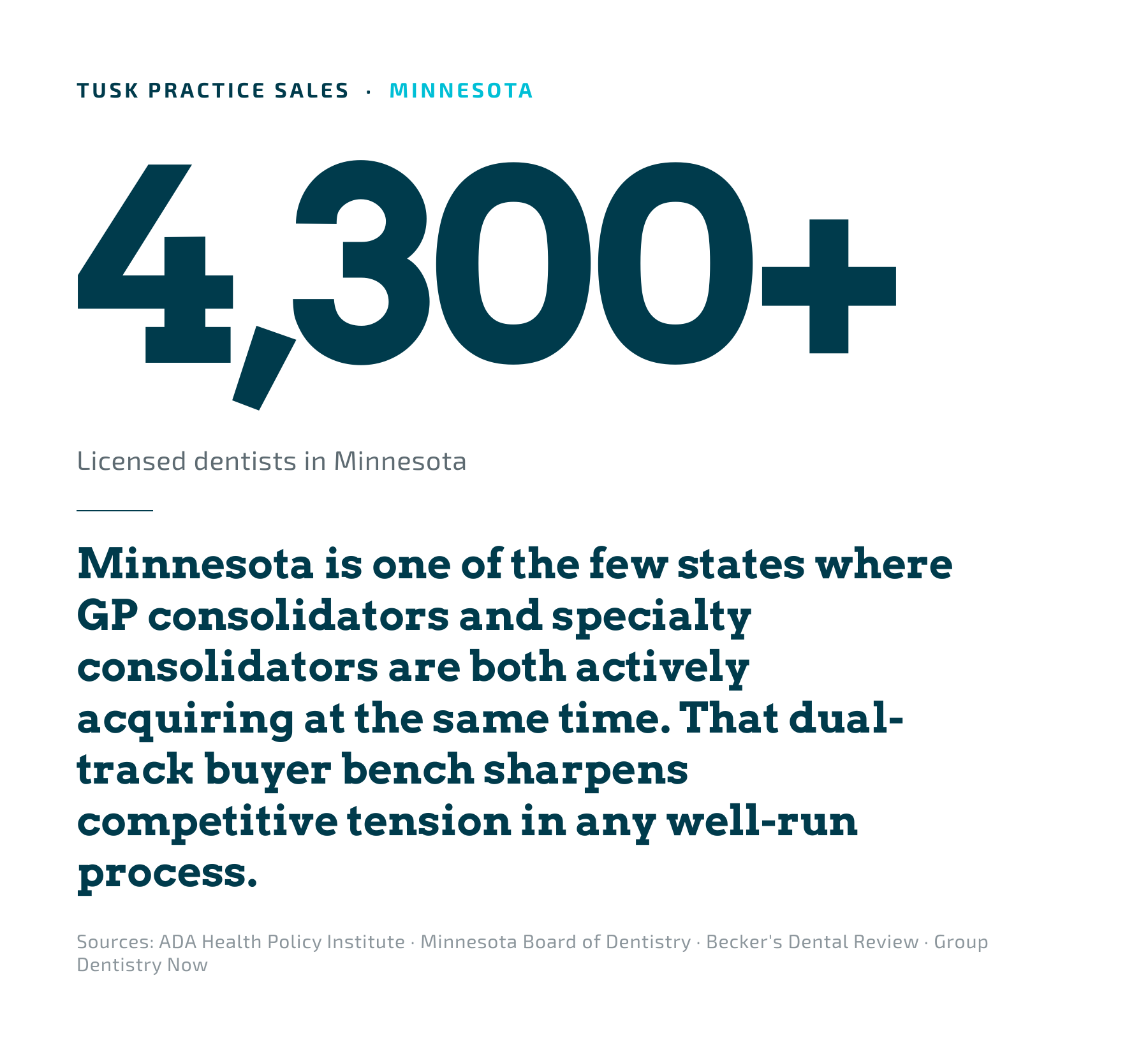
 Minnesota has more than 4,300 licensed dentists. What sets the state apart is what is happening on the buyer side. GP consolidators and specialty consolidators are both running active pipelines here at the same time. Most states have one or the other dominating. Minnesota has both. That extra layer of buyer competition benefits any MN owner, GP or specialty, in a properly run process. 

TUSK works only for sellers. We bring multiple qualified acquirers to the table, negotiate every LOI component, defend EBITDA through Quality of Earnings, and stay in the deal until the wire clears.

Start with a Valuation
Minnesota dental market overview. 4,300+ licensed dentists in a dual-track consolidation market

Minnesota Dental Practice Sales - Closed.

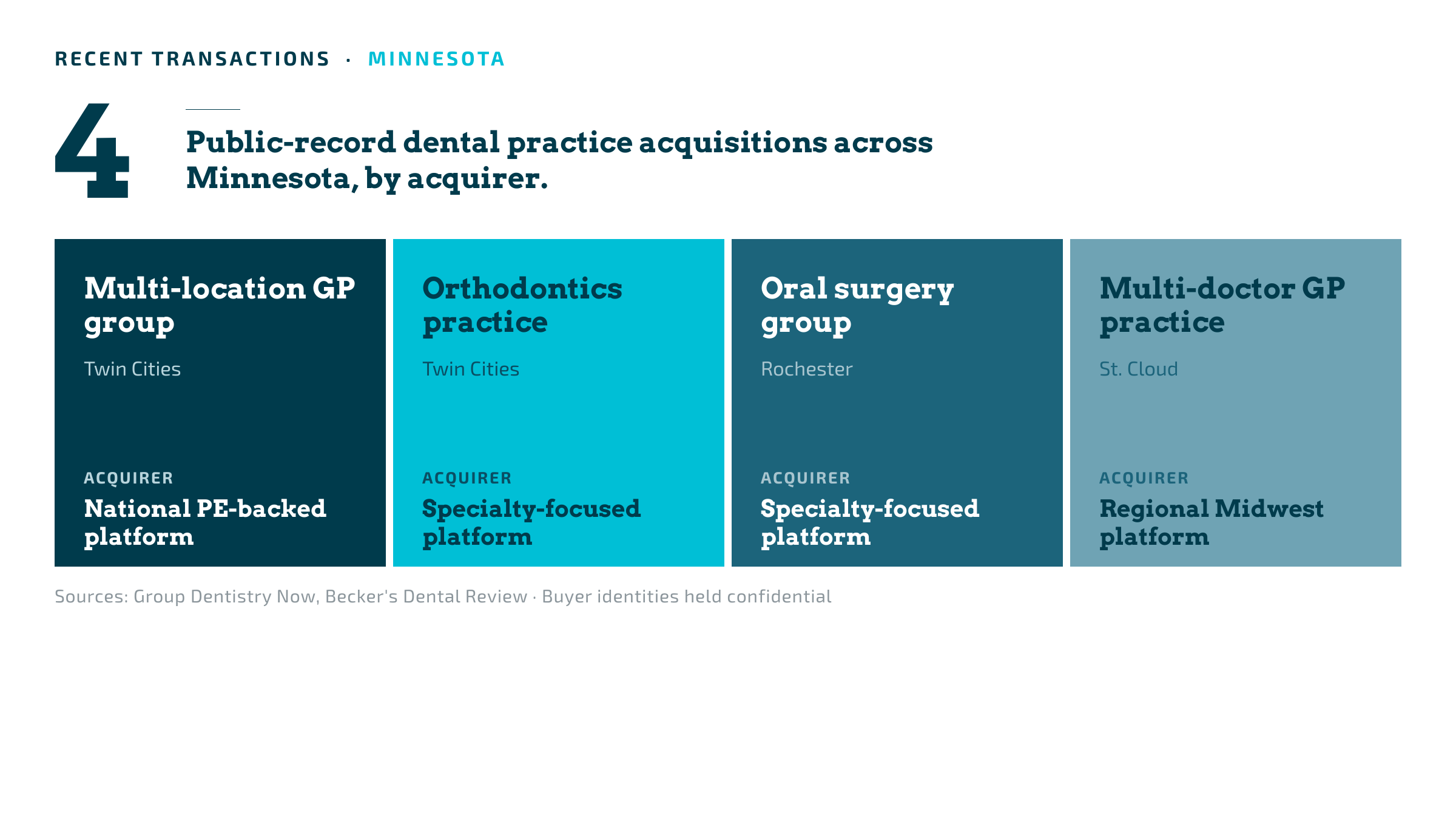
Minnesota dental practice owners are selling to some of the most active DSO and PE-backed buyers in the country. These are the groups competing for practices like yours.

Frame_3
Frame_2
Frame_1

Why Minnesota Owners Bring in Sell-Side Counsel Before Responding to an Offer.

Dual-Track Consolidation Deepens Your Acquirer Bench.
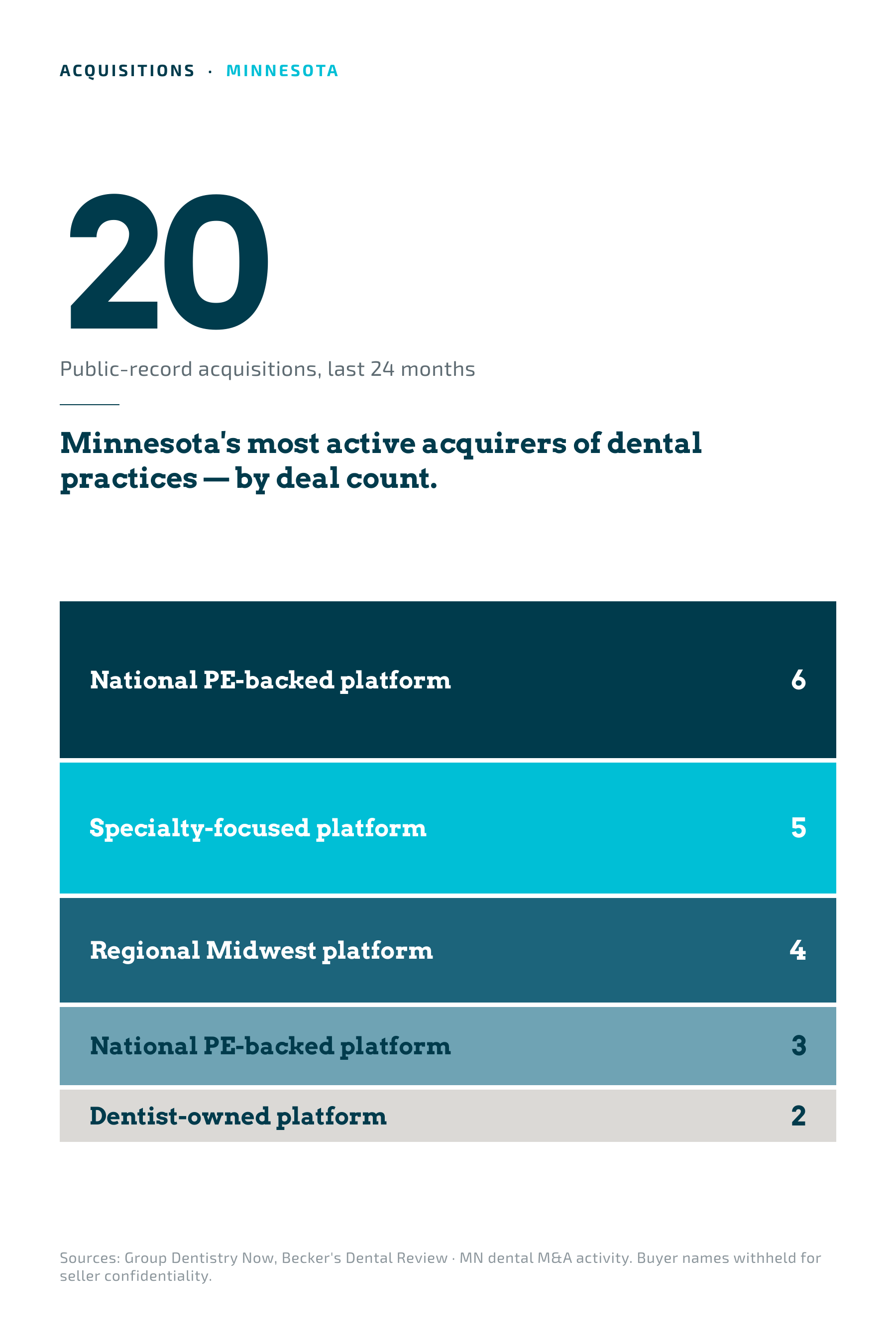
In most states, either GP platforms or specialty platforms drive the deal flow. Minnesota has both running full pipelines. That means a GP practice draws interest from GP consolidators and from hybrid platforms building both categories. A specialty practice draws interest from specialty consolidators and from GP platforms adding specialty capability. Either way, your acquirer bench is deeper here, and depth is what produces competitive tension on price and terms.

Buyer Activity Reaches Every Minnesota Metro.

Acquirer interest in Minnesota spans the Twin Cities, Rochester, Duluth, and St. Cloud. Different acquirers weight those markets differently based on where their existing operations sit. A single unsolicited offer represents one buyer's read of your practice, not the market's.

The Unsolicited Offer Is Calibrated to What You'll Accept.

Across TUSK's full sell-side practice, clients who arrived with an existing offer in hand closed, on average, 40% above that original number. An outbound offer is a probability weighted guess at what you will say yes to without shopping. A competitive process replaces that guess with real information.

Stress-Test Your Offer
Active acquirers of Minnesota dental practices by archetype

Proven Results for Minnesota Practice Owners

average

6+
Competing Offers Generated

On average, TUSK generates 6 or more LOIs per transaction. In Minnesota's active DSO market, that number frequently runs higher because more buyers means more leverage.

active

180+
Active Buyers in Our Network

Our buyer network includes 180+ DSOs, PE-backed groups, and strategic acquirers including the ones actively targeting Minnesota dental practices today.

providers

40%
Average Increase Over Initial Offer

TUSK clients close, on average, 40% above the initial offer they would have accepted without representation. Your first offer is almost never your best offer.

Minnesota Dentists. Real Numbers. Real Outcomes.

 These practice owners had the same questions you have right now. They received DSO offers. They wondered if the timing was right. They weren't sure who to trust. Here's what happened when they stopped navigating it alone. 

Dr. Philip Coniglio

5 stars

Owner of Suffolk Pediatric Dentistry & Orthodontics

“ Our practices have been at the forefront of dental care on Long Island for more than five decades. We trusted TUSK to identify the right DSO partner, one that aligned with our mission and helped us prepare thoughtfully for our next chapter. Their team went above and beyond to ensure we achieved both our financial objectives and the cultural fit that mattered most to us. We’re excited to partner with SALT Dental Partners and begin this new journey together. ”

Dr. James McDonnell

5 stars

Co-Founder of The Smile Lodge

“ From day one, we wanted an advisor who would match the thoughtfulness and professionalism we brought to building The Smile Lodge. TUSK Practice Sales earned our trust quickly. Their pediatric experience in New York, data-driven valuation work, and steady guidance through diligence gave us confidence at every step. ”

Mr. David Knopov

5 stars

Co-Founder of Gentle Dental World

“ The TUSK team was phenomenal throughout the entire process. Josh, Kevin, and Alex were there at every step of the process, ensuring we received the best deal for the great business our family has built in the Queens community. ”

How Minnesota Dental Practice Sales Actually Get Done.

Selling a dental practice in Minnesota isn't an event it's a process. The dentists who get the best outcomes are the ones who ran a structured, competitive go-to-market process with a sell-side advisor who works exclusively for them. Here's exactly what that looks like.

1

Discover

In a 30-minute strategy call, we map your financial picture, ownership structure, post-sale vision, and the specific outcome that would make this decision feel right. We need to understand what success looks like for you before a single buyer is ever contacted.

2

Educate

Most Minnesota dentists who've received a DSO offer don't know what it's actually worth because the headline enterprise value and the realized value are often very different numbers. We walk you through how buyers construct offers, what each component means, and what a competitive outcome looks like in your specific market.

3

Analyze

Our team compiles your financial and operational data, calculates your adjusted EBITDA, normalizes your add-backs, and builds the narrative and documentation that commands serious attention from the right buyers. This work is what separates an 8x deal from a 5x deal.

4

Negotiate

We take your practice to market through a structured, confidential go-to-market process reaching qualified buyers in a coordinated sequence that creates competition, not just conversation. Buyers know they're competing against other buyers. That knowledge alone moves price.

5

Close

We don't step back at the LOI. TUSK defends your EBITDA through Quality of Earnings, translates every page of legal documentation, and ensures that what was promised in the term sheet is exactly what you receive at close. The deal isn't done until the money is in your account.

Minnesota's Dental Community Is Well Connected. Confidentiality Matters.

Minnesota's practice owners connect through University of Minnesota School of Dentistry alumni networks, statewide continuing education circuits, and referral chains that cross every metro. One premature signal that you are exploring a sale costs leverage. Your associates, patients, competitors, and vendors do not need to know until you decide to tell them.

Every acquirer who receives a confidential information memorandum executes an NDA. We negotiate the term sheet, defend EBITDA through Quality of Earnings, and protect the confidentiality of your process until close.

Request a Confidential Valuation
Recent dental practice acquisitions across Minnesota
user-client1.jpg

Client Success Story

“TUSK had been part of my journey from early on, they knew how much I poured into this business. I needed a partner who understood that selling wasn’t just transactional—it was deeply personal.”

Dr. Lori Noga

Tranquility Dental Wellness

Read More

Orthodontist Turns Practice Sale Into Generational Wealth at 40

It’s not uncommon for practice owners to call because life has changed, and they want their time, risk exposure, and future flexibility to reflect that reality.

A successful, second-generation orthodontist in the Midwest had built a two-location orthodontic practice with a strong reputation and real momentum. Financially, they were doing what disciplined owners do: consistently saving, steadily building wealth, and staying on track for long-term independence.

But three events converged in a short window that shifted the question from “Are we on pace?” to “Are we structured the right way for the life we want next?”

A local competitor had been acquired by an orthodontic service organization. The market clearly supported premium valuations for dental practices like theirs. And most importantly, a close family member had been diagnosed with a condition that brought a new level of urgency to being present, reducing stressors at home, and making sure the family had margin.

This wasn’t about walking away from orthodontics. It was about rebalancing life and risk while the market would reward it.

About The Practice:

  • Specialty: Orthodontics
  • Structure: 40 Year Old Single-doctor owner, two locations (Midwest)
  • Family Dynamics: Orthodontist was married with three children (13, 10, 8) Wife heavily involved in practice administration while also managing the home full-time
  • Starting point: No financial pressure to sell; consistent annual savings, household net worth ~$6.6M, but unclear how the practice’s worth impacted net worth.

This was a proactive decision to convert performance into protection, while the owner still had years of optionality ahead.

They knew their net worth, but not their options…

After the triggering events mentioned above, they turned to their trusted wealth advisor to understand their opportunities. The conversations led to more questions about:

  • How much of their household wealth was truly tied up in the practice?
  • If the market was favorable, what did “good timing” to sell their orthodontic practice actually mean in dollars and terms?
  • What would an orthodontic practice sale look like if the goal was to reduce clinical hours gradually, not abruptly?
  • How could they reduce the administrative load on the spouse without destabilizing operations?

Their wealth advisor introduced them to TUSK to run a valuation and pressure-test real exit paths. Once we ran the analysis and mapped the practice value against the household balance sheet and their personal goals, the decision-making became clear.

The valuation was the turning point.

It didn’t just produce a number. It translated the practice into a strategy on liquidity, risk reduction, and time.

What Success Looked Like In This Orthodontic Practice Sale

What they wanted was specific:

  • Take chips off the table and convert years of work into real liquidity
  • Reduce leverage and personal exposure so the family wasn’t carrying unnecessary risk
  • Create a path to step down clinically over time & reduce the administrative burden on the spouse
  • Protect culture, patient experience, and clinical autonomy across both locations
  • Select a partner aligned with how they wanted to operate, not just what they could pay

TUSK’s Approach: Create Leverage, Then Protect The Result

Our job as the orthodontist’s sell-side advisor was to find the right partner that would be able to achieve the financial and cultural elements the owner was looking for in the deal via our marketed sales process. The doctor was a young 40-year-old and was willing to stay for a minimum of 5 years, and knew they would be working alongside the buyer for that period of time. TUSK set out to canvas the market and bring multiple offers for our client to choose from.

We positioned the practice as a premium orthodontic asset with a clear growth and operational story, but we were equally direct about what mattered most to the owner: the right partner, the right structure, and the ability to protect the family’s time and stability.

Then we took it to market the right way, broad enough to create competitive tension, narrow enough to stay focused on fit.

Process Results:

  • 23 buyers brought to the table
  • 11 NDAs executed
  • 3 unique offers received from groups the owner was most excited to partner with

“TUSK introduced us to DSOs we didn’t even know existed.” 

The Decision: They Didn’t Choose The Highest Offer

Once the doctor had three real offers from respected groups, the decision became more nuanced because the “best deal” is rarely defined by headline value alone.

This owner chose the partner that aligned with their team, their culture, and their long-term autonomy, not the offer with the highest enterprise value. And because we had created legitimate leverage in the process, they had the freedom to make that choice without sacrificing outcomes elsewhere. An important feature of their deal was the group was nearing a recapitalization event compared to the other groups, allowing them to monetize on their equity sooner.

Fit mattered because this wasn’t an exit. It was a transition.

The winning partner was the one who could operationalize the owner’s gradual step-back, reduce friction for the spouse, and protect the practice’s culture across both locations.

The Outcome: Reduced Risk, More Flexibility, & Meaningful Time Back

The outcome was exactly what they came to the table for, just executed earlier in their lifespan than they originally thought possible.

They reduced leverage and personal risk while the market was favorable. They increased financial security at age 40, which created real flexibility around how aggressively they needed to work. And the day-to-day burden on the spouse eased, because the practice no longer required the same level of administrative weight from within the household.

The owner signed a five-year employment agreement with a clear plan to gradually reduce clinical hours over time, maintaining continuity for patients and staff while moving toward the family-first structure they wanted.

Why This Worked And What Doctors Can Learn From It

This is what we see repeatedly in premium transitions:

  • The strongest deals often happen when the owner is informed and prepared
  • Clarity on goals drives better structure and better partner selection
  • A controlled marketed sales process creates leverage, and leverage protects terms
  • The “right” buyer is the group that can support the owner’s future, not just purchase the past

The Takeaway
If you want to reduce risk and reclaim time while you’re still young enough to enjoy it, the first step isn’t deciding to sell. It’s understanding what your practice is worth and what options that value creates.

For owners weighing a similar decision

If you’ve experienced a life event that changes your priorities or you simply want to reduce risk while the market is strong, you don’t have to start with a binary decision.

Start with clarity.

A valuation, paired with a real conversation about goals and structure, will tell you what’s possible and what a smart transition could look like without sacrificing autonomy or culture.

What Minnesota Dentists Need to Know Before They Sell.

The Minnesota DSO market moves fast. These resources give you the market intelligence buyers don't want you to have - so you walk into every conversation prepared.

Frequently Asked Questions - Selling a Dental Practice in Minnesota

Minnesota sits in the top tier of national dental M&A activity, and it is one of the rare states where GP and specialty consolidation are both running full pipelines at the same time. Deal flow reaches the Twin Cities, Rochester, Duluth, and St. Cloud, across both practice categories. TUSK identifies the qualified acquirers for your specific practice profile inside a confidential valuation conversation.

The offer in your inbox is one buyer's estimate of what you would take, not what your practice would clear in a real process. Across TUSK's sell-side practice, clients with an existing offer walked away 40% higher on average after we ran a proper process. In Minnesota that gap sharpens further, because the dual-track buyer bench means the archetype that ends up winning your practice is often not the one that made the first move.

Six to nine months from engagement to funded close. A month or two of preparation, a month building the acquirer set and executing NDAs, a month working the offers, and sixty to ninety days for diligence and legal close. The Minnesota buyer competition typically shows up early once a structured process starts.

Adjusted EBITDA times a market multiple. Minnesota's dual-track consolidation dynamic widens the achievable multiple range, because GP and specialty acquirers both bid on the strongest practices in the state. Where your practice sits inside that range depends on provider retention, revenue growth, procedure mix, payer mix, and financial reporting quality. TUSK provides the formal valuation at no cost.

Not at all. Twelve to twenty four months out is when owners actually build leverage. That window lets you position for the acquirer archetype most likely to compete hardest for your practice. Owners who prepare properly consistently see valuation improvements of thirty percent or more before an LOI is signed.

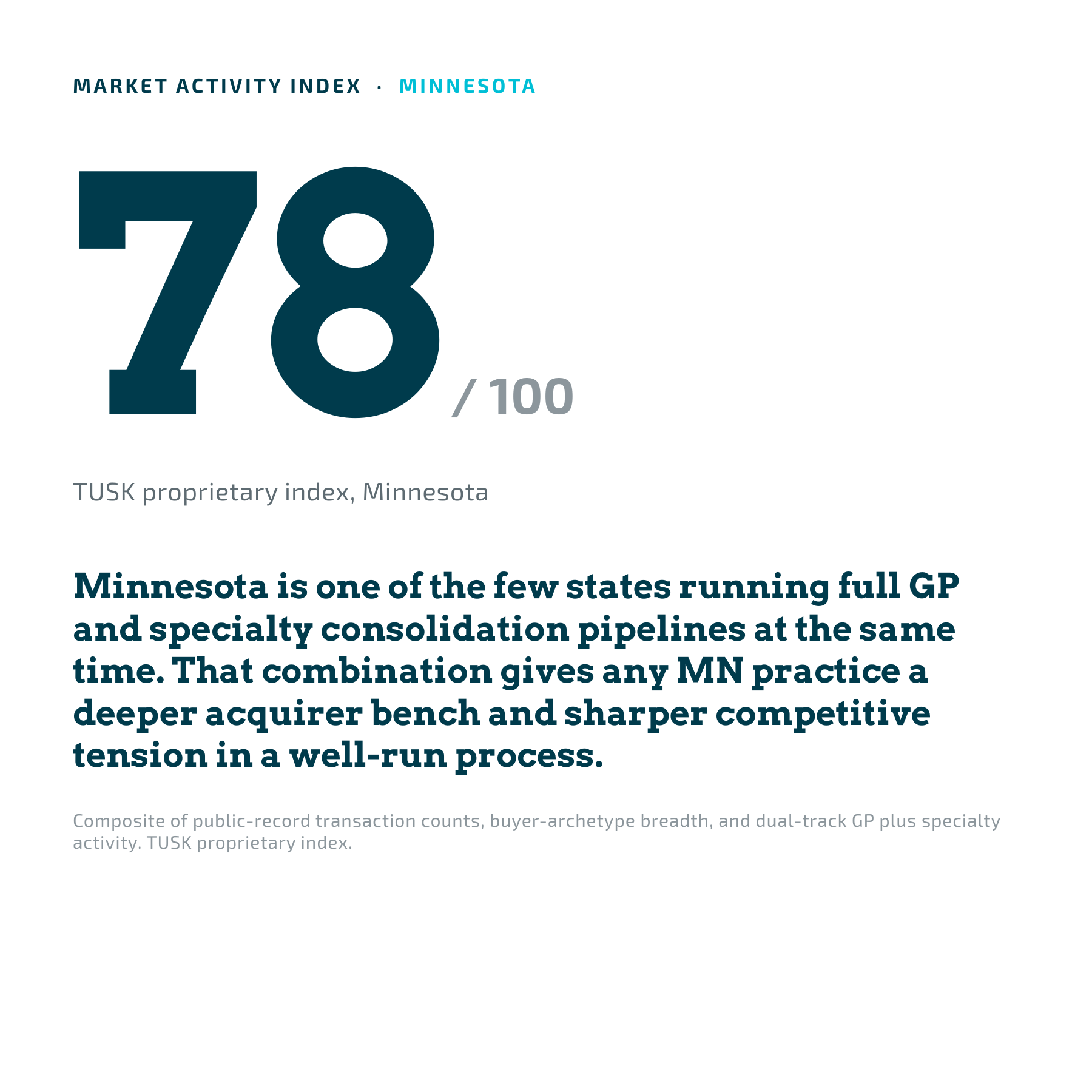
Minnesota dental practice market activity index

Minnesota Sellers Have a Deeper Buyer Bench Than Most States. Start With a Valuation.

Minnesota practices are closing right now across the Twin Cities, Rochester, Duluth, and St. Cloud with multiple competing acquirers, on terms they helped shape, represented by sell-side counsel who works only for them. A confidential valuation is where every successful sale begins. No commitment.

Contact Us

Request a Confidential Valuation

Prepared by TUSK's team. We respond within two business days.